Monday, March 26, 2007

Rare exhibition of 2000 yr old frescoes

Here's an exhibit not to miss if you can hie thyself to Madison WI between now and June 3rd, '07 ... Stabiano: Exploring the Ancient Seaside Villas of the Roman Elite. The Chazen Museum of Art has mounted an extremely rare exhibition of 2000 year old frescoes that have never before this tour been seen in the US.

In the first centuries BC and AD, the sumptuous villas dotted all around the Bay of Naples served as summer residences for leisure and political entertaining . In the hot months Rome was empty of the rich and powerful, and the area surrounding the Bay of Naples became the virtual capital of the Empire.

The villas were designed to provide fabulous views of the Bay and also contained serene garden courtyards. According to ArtDaily.org , the exhibition features twenty-six remarkably well-preserved fresco wall paintings and eleven wall reliefs made of stucco among the more than seventy works of art and artifacts recovered from five partially-excavated ancient Roman villas located in Stabiae.

The eruption of Mt. Vesuvius in 79 a.d. destroyed a wide swath of populated territory, bringing an end to the area's era of affluence. But the thick layer of ash and pumice functioned exceptionally well as a preservative, and the Restoring Ancient Stabiae Foundation has as its mission the excavation and conservation of at least two of the enormous villas and the transformation of the site into one of the largest archaeological parks in modern Europe. The site of Stabiae (Castellammare di Stabia) is 2.5 miles from Pompeii and is currently open to the public.

The four-year tour of this exhibition represents the first long-term loan of major cultural treasures from Italy to the U.S. After Madison, it will travel to the Dallas Museum of Art, Dallas, TX (July 8 – October 7) and then to the Cummer Museum of Art & Gardens, Jacksonville, FL (November 7- Feb 3, 2007/08).

Wednesday, March 21, 2007

Celebrating Easter on the Wrong Date?

For many of us it’s just one of those bits of knowledge that we absorbed somewhere along the way: Easter falls on different dates for the Latin and Greek Orthodox churches. We know it, and it never occurs to us to wonder about it, until someone asks the question – a child, maybe, or a Jeopardy contestant.

The Pope endorses his scientific advisors’
GregorianCalendar Reform
Detail from Gregory XIII tomb
by Camillo Rusconi, St. Peter’s Basilica, Rome

Why does Easter fall on different dates in the Latin Church and the Greek Orthodox Church? And which one’s the “right” one? Until the latter part of the 16th century, all Christians celebrated Easter on the same date. So what happened? The answer is found in a fascinating little slice of history.

Ancient calendars were based on the lunar cycle until around 45 BC, when Julius Caesar decided that his vast Roman Empire should adopt a new calendar, one based upon the earth's revolution around the sun. By giving up a link with the moon, the Julian calendar – so-called in honor of Caesar -- gained about three days every 400 years. By the 16th century, this error had accumulated to 10 days, and the discrepancy between the calendar dates of the solstices and the actual occurrence of the solstices had become a real concern to the Roman Church.

The long-standing formula for dating Easter depended upon the lunar cycle and the vernal equinox. Easter was being celebrated on the wrong date!

A solution challenged astronomers and mathematicians until 1582. Pope Gregory XIII endorsed their recommendations to modify the calendar and the new Gregorian Calendar changed leap-year rules to synchronize with the solar year -- to an accuracy of about 1 day in 2500 years!

To adjust for the discrepancy that had accumulated since 45 BC, the year 1582 was shortened by 10 days. The days between October 4th and 15th were abolished. So that the last day of the Julian calendar, October 4, 1582, was followed by the first day of the Gregorian calendar, October 15! Roman Catholics and Protestants use the Gregorian calendar, while Greek Orthodox Christians base their liturgical dates on a much older calendar.
How come?

The 16th Century was the era of the Protestant Reformation, and papal decrees carried little weight with non-Catholic Christians, so Gregory’s calendar reform was not soon adopted in Protestant countries. By the time Britain adopted it in 1752, an eleventh day had to be dropped. Russia didn’t adopt it until the 20th C. That’s why the October Revolution of 1917 actually occurred in November!

The Greek Orthodox Church has never endorsed the Gregorian Reform of the Calendar, so Orthodox Easter (and Christmas) falls some days later than the same celebrations in the Latin Church.

Saturday, March 03, 2007

Seeing ancient structures as they were


"The aqueducts had to drop the width of a finger every 100 yards -- any more and the flow would rupture the walls; any less and the water would lie stagnant ...

Their greatest glories, such as the triple-tiered bridge in southern Gaul, the highest in the world, that carried the aqueduct of Nemausus, were frequently far from human view. Sometimes it was only the eagles, soaring in the hot air above some lonely mountainscape, who could appreciate the true majesty of what men had wrought. " Pompeii, by Robert Harris


As isolated as it was then, these days the Pont du Gard attracts well over a million visitors a year! I am often struck by how hard it is for us to imagine the original context of historic sites while one's senses are being assaulted by the jostle of fellow tourists, the babel of languages, the din and smell of tour buses.
Parenthertically: This speaks to one of the benefits of audio guides: Headphones help blockout distracting sound, and an engaging narrator can bring the original context into the present, and convey the true meaning of the site.
According to Wikipedia, the Pont du Gard was designed to carry water across the small Gardon river valley. It was part of a nearly 50 km (31 mi) aqueduct that brought water from springs near Uzès to the Roman city of Nemausus (Nîmes). The full aqueduct had a gradient of 34 cm/km (1/3000), descending only 17 m vertically in its entire length and delivering 20,000 cubic meters (44 million gallons) of water daily. http://www.pontdugard.fr/index.php?langue=GB

How hard it is for us to apprehend the magnitude of the accomplishments of Roman engineers! The aqueduct was constructed entirely without the use of mortar, probably during the 1st Century. The stones – some of which weigh up to 6 tons – are held together with iron clamps.
And still it stands! In 1998 the Pont du Gard was hit by a major flood which caused widespread damage in the area. The road leading up to the bridge and neighboring structures were badly damaged, but the aqueduct itself was not seriously harmed.

Saturday, January 20, 2007

But Is It Art?


I've just finished reading an engaging little book by Cynthia Freeland, called But Is It Art?.

The day before I started to read it someone was telling me about how he sees art in everything, so it seemed a nice coincidence that, only two pages into her book, Freeland writes that many people "would not distinguish art from artefact or ritual. Medieval European Christians did not make art as such, but tried to emulate and celebrate God's beauty. In classical Japanese aesthetics, art might include things unexpected to modern Westerners, like a garden, sword, calligraphy scroll, or tea ceremony.”

This resonated for me because I consider virtually anything made by human hands to be art ... not always necessarily good art, but art nonetheless! I also see art and architecture in nature. It's all there: form, color, line, pattern, compositional balance ...

I take particular pleasure in architectural detail. But I've observed that relatively few people seem to notice it. In Italy there are exquisite floors everywhere you look, painstakingly laid centuries ago by amazingly skilled craftsmen; but most people don't seem to notice what's under foot.


I feel fortunate to have "seeing eyes", and part of my purpose in creating Jane's Smart Art audio guides is to help others see in art and architecture what I see, and then to explore the historical context that provides meaning. I love the exploration process!

If you’ve ever wanted to learn a bit about art theory, but have been put off by arcane and pompous grandstanding, then I recommend Freeland’s lively little book, But Is It Art?: An Introduction to Art Theory. It’s very readable and – although not an in-depth review of aesthetic theory – enlightening: “eye-opening” in the sense of enlarging one’s ability to thoughtfully see “art” where previously one might have reacted with disinterest, perplexity, amusement or disapproval. Freeland is Professor of Philosophy at the University of Houston, and an active member of the American Society for Aesthetics, so she knows whereof she speaks!

Saturday, December 16, 2006

St. Paul's New Morality

I've long been uncomfortable with the saying, "That's not very Christian ... ." It strikes me as insulting to all the good people who hold other theological beliefs. But when I overheard it said again recently, I began to wonder what it really means.

I'm currently reading Bruce Shelley's Church History in Plain Language, and I've just come across the answer to the question. Shelley attributes the following words to the apostle Paul:
"The fruit of the Spirit is love, joy, peace, patience, kindness, goodness, faithfulness, gentleness, and self-control." (Galatians. 5:22-23)

According to Shelley, "Spiritual regeneration and the moral life were not merely one side of Christianity to Paul but its very fruit and goal on earth."

Little wonder, then, that the new Christian message was so appealing to so many in the Roman world -- where slavery, cruel punishments like crucifixion, and beastly entertainments like gladiatorial combat were accepted. Paul himself, initially a persecutor of those Jews who believed in Christ as the Messiah, "saw the light" and became an apostolic messenger. Caravaggio represented Paul's conversion in this image in the Cerasi Chapel in Sta. Maria del Popolo in Rome.

So, "That's not very Christian ... " refers to the moral origins of Christian belief. Others can of course be good, moral people. But to be a true Christian requires living to a high standard of "love, joy, peace, patience, kindness, goodness, faithfulness, gentleness, and self-control."

Does the most moving Christian art reflect this spirit?

Wednesday, November 29, 2006

Alinari National Museum of Photography Now Open

A month ago, in Florence, the new Alinari National Museum of Photography opened in a renovated historic structure in Piazza Santa Maria Novella.

Now the collection from the fabulous Alinari Archives will be displayed to the public, representing an astonishing patrimony of documentary material pertaining to art, history, folklore, landscape, industry and society. The particularly exciting thing to me is that Alinari has, from the beginning, specialized (among other things) in the documentation of works of art and historic monuments.

Founded in Florence in 1852, Fratelli Alinari is the oldest photography firm in the world. Through Alinari photographs – dating from the second half of the 19thC to the present – the history, society, art and culture of Italy and Europe and the rest of the world, have been preserved and catalogued.

Alinari owns more than 3.5 million images, plus the firm manages or represents more than 21 million photos owned by other organizations, including 400,000 images from the archive of the Touring Club Italiano.

Not going to be in Florence any time soon? You can gain on-line access to the Alinari Archive at http://www.alinariarchives.it/login/index.asp?languageID= The website also has a bookstore with interesting books of photography, and also selections of cards.

According to the official press release announcing the opening, “The itinerary begins with the year 1839, with the first daguerreotypes, and goes as far as the digital images and photocellular phones of today. It is a fascinating itinerary that journeys through the era of the pioneers; the new world of a picture that can be technically reproduced, thus revolutionizing possibilities for knowing and seeing; … the relentless technological advances which created a market for everyone; photography which refines its language to become an art; and an infinite number of promotional objects. Hundreds of rare photographs, vintage objects, cameras of the past and the most up to date … in a presentation designed by the Oscar winning film director Giuseppe Tornatore."

There is also a space for temporary exhibits. The first themed display is called View of Italy, 1841-1941: The Great Masters of Italian Photography in the Alinari Collections.

Finally, one very interesting first-of-its-kind experiment that the Museum developed in collaboration with the Stamperia Braille of the Region of Tuscany is the “touch tour for the blind.” It’s a unique collection of 20 pictures re-created in relief to be seen by the blind through touch. Even as a sighted person, I look forward to experiencing the touch tour. I wonder if feeling the dimensionality of an image will enhance my seeing in any way.

In the words of Florence’s mayor Leonardo Domenici “The MNAF ( Museo Nazionale Alinari della Fotografia) is a new treasure for Florence, a museum of modernity of exceptional cultural value. It also has allowed the city to reclaim in the best of ways the historical Leopoldine complex threatened with deterioration. Once restoration is completed the complex will also house the Museo del Novecento (20th C) dedicated to contemporary Italian art.”

I won’t be in Florence again until next Fall, so I’ll have to make do ‘til then with on-line access to the archive. But the MNAF will definitley be on my itinerary when I do get there!

Tuesday, November 14, 2006

Fra Angelico Hiding in the Bedroom!


If you have a love for early Renaissance art -- perhaps Fra Angelico in particular -- (or if you're a fan of The Antiques Roadshow) the recent discovery of two Fra Angelico panels in a modest home in Oxford, England, should give you a little shiver of excitement!

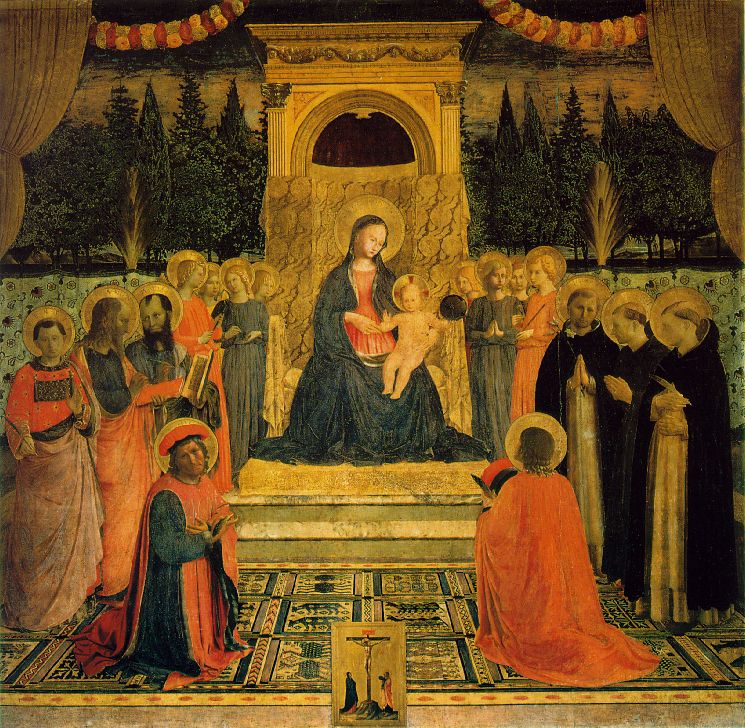
The panels are recognized by art experts as being from the San Marco Altarpiece, painted by Fra Angelico, c. 1439, commissioned by Cosimo dei Medici. The central panel of the altarpiece is still at San Marco, but the smaller panels surrounding it were dismantled 200 years ago during Napoleon's occupation of Italy. Today most of these secondary panels can be seen in Museums scattered around the world. Some, however, remained unaccounted for, including these two. I wonder how many of these little treaures remain lost.

According to a Reuters report from London, two panels painted in tempera on a gold background, each showing a standing figure of a Dominican saint, were found tucked away behind a bedroom door by an art auctioneer who had been asked to carry out a valuation after the owner of the house died in July. The homeowner, a librarian, had retrieved the paintings from a box of odds and ends while working as a manuscript curator at a museum in Huntington, California, in the 1960s. Unaware that they were by Fra Angelico, she thought they were "quite nice" and persuaded her father to buy them for a few hundred pounds. Today, they are expected to bring more than a million pounds at auction.

"We are dealing with two works of art painted by one of the 'greats', intended for his own church and commissioned by one of the greatest art patrons in history," the auctioneer, Guy Schwinge, said in a statement. "It simply does not get much better than that."

Wednesday, November 01, 2006

Angels Of The Mud


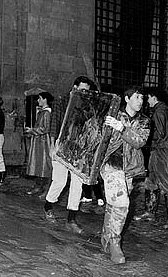
On November 4th, 1966 -- after days of rain -- the Arno flooded its banks to a depth of roughly 12 feet, destroying everything in its path. As an impassioned 16-year-old, I had fallen in love with Florence in April of that year, and I remember that hearing the news of the flood affected me as nothing had ever done before in my short life. When I heard that people from all over the world were converging to help with the clean-up, I begged my parents to let me take a semester off from high school ... to no avail.

If I were forced to produce a list of my regrets in life, that would be one of them. Had I been a couple of years older I would have gone to Florence to be one of what were soon dubbed as "gli angeli del fango" -- the angels of the mud.

The official Angeli del Fango website is definitely worth looking at, with photos and videos and eye-witness accounts of the event and its aftermath. To see images of the water rushing through streets and past the Duomo, and to see priceless frescoes and sculpture blackened with filth is really sobering. It's hard to imagine today what an undertaking it was, how extensive was the damage to a vast amount of irreplacible art.

This Saturday will be the 40th anniversary of that heart-wrenching event, and a reunion of "gli angeli" will take place in Florence.

Hats off to the volunteer angels and the professional restorers who slogged through muck for months,living in seriously uncomfortable conditions, to reclaim the city's artistic and architectural heritage from the mud.

Friday, October 27, 2006

Pope Descends into Chasm in the Earth


I've just come across something that I would definitely have included in the Jane's Smart Art Audio Guide to St. Peter's Basilica had I known it.

According to R.A. Scotti, in her recent book about the building of St. Peter's, Basilica, the trench excavated for the foundation of Bramante's enormous piers was 25 feet deep. Think about it ... dug by hand, the mucky soil drawn up from the depths, bucket load by bucket load ... a 25 foot deep trench running the circumference of each massive pier is a huge amount of earth-moving!

Scotti's description of the ceremony which was held at first light on April 18th, 1506, is delightful. She tells of a fierce wind whipping at the cardinals' crimson cassocks, and the bull-like figure of Pope Juilius II visible above the sea of humanity, tossing commemorative coins into the crowd as he was borne to the site, seated in a sedia gestatoria.

"Two masons descended first, followed by two cardinals, and then the pope, grim-faced. He climbed down the ladder carefully, his ringed fingers grasping the rungs, encumbered by the heavy clothing, the weighty tiara, descending lower, lower yet. The Ager Vaticanus was marshy, the earth in the pit damp, the air close."

"As Julius disappeared into the trough, the crowd pressed forward for a better view. Dirt flew, striking his tiara. For a terrifying moment he thought the sides would cave in and bury him. ... The trench was 'like a chasm in the earth,' the papal master of ceremonies, Paris de Grassis, recorded in his journal, 'and as there was much anxiety felt lest the ground should give way, Pope Julius thundered out to those above not to come to nearer the edge.'"

I love the visual image of this burly white-haired pontiff, larger-than-life and glorious in voluminous brocade, jewels a-glitter, descending gingerly into the muddy pit to lay the first stone in the foundation of what was to become, over the course of two centuries, one of the most remarkable achievements of the Renaissance.

Sunday, October 15, 2006

One ought to be required to pass a test before being permitted to enter St. Mark's

Miss Julia Garnet's severe schoolmarmishness was overwhelmed by the mysteries and aesthetics of Venice. Nonetheless, stern criticism did still invade her new-found generosity of spirit from time to time:

"The Japanese were out in force again. A party stopped and aimed a bank of phallic cameras at Adam and Eve. No wonder they felt embarrassed in their nakedness. Julia turned aside in disgust. Really, she thought, it should be made difficult not more easy to get to places of beauty. One ought to be required to pass a test before being permitted to enter St. Mark's."

This passage evoked my own recollections of techno-buff tourists with their large-lensed digitals or purring video cameras. Yes, they are often Japanese - who do seem to travel in little swarms --but most any nationality can be substituted in this picture.

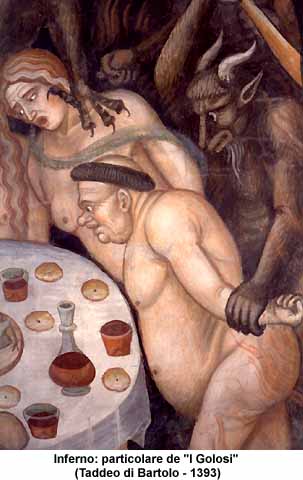
Julia's uncharitable thoughts about the Japanese in St. Mark's Basilica reminded me of an incident in the Duomo, called La Collegiata, in San Gimigniano. I had been standing for a long time, awe-struck, below Taddeo di Bartolo's Last Judgement, taking in the gruesomely graphic -- even pornographic, some might say -- portrayal of what the Damned have to look forward to on the day of judgment. Out of respect for some readers' sensibilities, by way of illustration I have chosen to show Gluttony, one of the tamer details of the fresco.

Despite knowing that the intent of the horrific scenes was to strike fear in the hearts of mortal Christians, I was startled to find such images in a church, and I stood crunching my neck in the dim light, trying to take it all in. Suddenly, a tall, lanky middle-aged American man was at my elbow. His video camera whirred softly as he panned down the length of the fresco, his voice reverently low as he recorded his caption, "This is another painting in another church in Italy."

Guessing that he had no idea what he'd just filmed, I resented the intrusion --- until I imagined him getting home and sitting Granny and the kids down to show them the video of his trip to Italy. SURPRISE! That brought tears of malicious mirth to my eyes! Just that morning I had been lamenting how crowded Europe has become, as great numbers of people from all over the world have gained the economic means to travel. If they travel because they are really interested, I thought, that's a good thing. But if they are simply accumulating bragging rights, adding one more place to the list of where they've been, then that's something else entirely! In retrospect, it was very Miss Garnet -- strict and uncharitable -- of me!

Miss Garnet's Angel by Salley Vickers would be a delightful book to read before your next trip to Venice. I suppose some might read it as a simple story of a spinster tuning in to Venice. But, as the layers are peeled back, there's a thought-provoking ethereal depth to it that I found intellectually gratifying.