Sunday, December 13, 2009

Once in a Lifetime

Thomas Hoving died on Thursday. Hoving was the colorful and controversial director of the Metropolitan Museum of Art in New York from 1967 to 1977, and was known as – if not the inventor of -- certainly the champion of the Blockbuster Exhibit. His idea was to bring to us -- through a temporary exhibition -- art that we would have a very hard time seeing on our own.

On Friday I heard part of the re-broadcast of a 1993 NPR interview with Hoving. In part of the interview he talked about how the day of the blockbuster exhibit is over.

He said, “They’re not really blockbusters anymore ... They SAY they are, but … there’d be a great show of Caravaggio in which there are three Caravaggios and the rest are followers. Art prices have risen to such ridiculously astronomical heights that nobody can afford the cost of insurance and other things to bring the works of you-name-it into one place any more … it’s virtually impossible to do … people are unwilling to lend anymore, and it’s too costly.”

Interesting that he used Caravaggio as his example back in 1993 … because today I learned about an upcoming Caravaggio exhibition that sure sounds like a blockbuster to me!

Between February 18 and June 13, 2010, Caravaggio 's entire career will be on view at Rome’s Scuderie del Quirinale. WOW!

In honor of the 400th anniversary of the death of Michelangelo Merisi da Caravaggio, the show will bring together masterpieces from museums around the world. These include the two versions of the Supper at Emmaus, on loan from the National Gallery in London and Milan’s Pinacoteca di Brera; The Musicians from Hoving’s own Metropolitan Museum, Bacchus from the Uffizi, Boy with Lute from the Hermitage in St Petersburg; Amor Omnia Vincit from Berlin’s Gemäldegalerie; the three versions of Saint John the Baptist, from the Capitoline Museums and the Galleria Corsini in Rome, and the Nelson-Atkins Museum in Kansas City.

Even some works which are rarely loaned out will be included: The Deposition from the Vatican Museums, The Annunciation from the Museum of Nancy (which was restored for the occasion); and The Crowning of Thorns from the Kunsthistorisches Museum in Vienna.

WOW!

Almost the entirety of Caravaggio’s artistic production will be on view in Rome: the paintings brought together for the exhibition, plus, of course, the numerous Caravaggios that are on view in Rome’s churches, still displayed in the chapels for which they were originally commissioned.

This will be a once-in-a-lifetime opportunity for art pilgrims to experience a near-complete Caravaggio anthology gathered in one place.

Did I already say “WOW”?

Saturday, December 12, 2009

Part 3, Woe Is Me


This may be the final installment of what seems to have turned into a series on the disappointments art-lovers encounter in their travels.

One of my favorite churches in Rome holds two exceptional Caravaggio panels, two Bernini sculptures in a chapel designed by Raphael, plus work by Bregno, Pinturicchio, Bramante, and unusual (for Rome) stained glass windows.

I try to get to Sta. Maria del Popolo every time I’m in Rome. Last month we popped in to capture a few images that we still needed to create a virtual tour.
With us were our Rome-virgin friends, Bob & Barbara, who had all the Jane’s Smart Art Guides Rome titles loaded onto their iPods and were systematically knocking them off, one per day.

Oh no! Caravaggio’s Conversion of St Paul was gone! (On loan to the Barberini Museum, so admittedly still viewable in Rome by diehard Caravaggio pilgrims).
At least now we can say we know what the behind-the-scenes support for Caravaggio's Cerasi Chapel panels looks like!

And this is how Raphael & Bernini's Chigi Chapel looked:

Friday, December 11, 2009

In Restauro

And speaking of closed…

We’ve recently returned from a photo-shoot in Rome, in preparation for an upcoming Jane’s Smart Art Guides virtual tour title: The Fountains of Rome.

It’s definitely a good thing that Rome's monuments are being maintained, but what an irritation it is to find the very thing you’re there to see ensconced behind scaffolding!

We found the all-important Fountain of Moses “in restauro”.

Note that the image of the fountain has been reproduced on the scrim. This is something the Italians have been doing for some time now, so that the monument under restoration remains (sort of) visible. More recently, however, the siren-song of ad revenue has raised its ubiquitous head and the decorative scrims now inevitably sport some commercial message or another. The fact that this ad block is still blank suggests that the scaffolding has only recently gone up. Given the pace of things Italian, Moses could still be up to his neck in scaffolding this time next year.

The Fontana dei Tartarughe (Turtles Fountain), in the lovely little Piazza Mattei, was also fenced off for “lavoro”. Fortunately Michael has become quite adept at capturing images through barriers!

It looked pretty well finished– save for an empty red plastic bucket and scrub broom left in the basin -- so there’s a good chance that the fencing is down by now, with water flowing once again.

Lacoste is helping to pay for the restoration of a building on Piazza di Spagna.


Thursday, December 03, 2009

Attention Art-Lovers: Paris Is Closed

The frequency of work stoppages in western European countries is amusing until – as a traveller who’s taken time off and paid a lot of money for airfare and lodging – your trip is ruined by a strike.

This is a favorite time of year for travellers who like to spend their time inside museums … iffy weather isn’t an issue. The lack of tourist crowds more than compensates for the drizzly days.

But this week, innumerable art-lovers are travelling to Paris only to discover that the Louvre, the Pompidou Center , the Musee d’Orsay, the Rodin Museum, Ste.-Chapelle, the Arc de Triomphe, and Versailles are all closed -- "en greve".

The strike is a result of a dispute between the unionized museum workers and the Ministry of Culture over cost-cutting measures. It started at the Pompidou last week and has now spread to dozens of large and small cultural sites in and around Paris.

Today MSNBC reports that the strike appears “to be gathering steam”. Called by all seven unions representing culture ministry employees, the open-ended work stoppage is to protest the government’s plan to drastically reduce the size of the civil service by replacing only half of employees who retire.

Workers at each museum are voting each day to determine the duration of the strike. The website of each museum will be your best source of information about their status.


Saturday, November 28, 2009

Beauty ... a path toward the transcendent

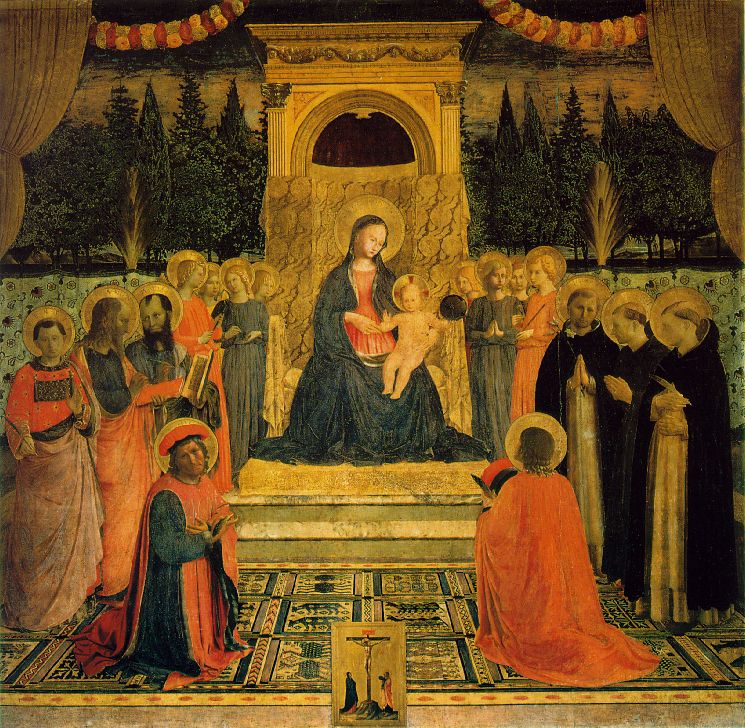
Pope Benedict believes that art can be used to overcome the complacent secularity of today’s western culture. To understand this view, think of Fra Angelico’s 15th century Madonnas. Then think about our 20th century Madonna.


Last Saturday, the Pope spoke to more than 250 of today’s leading painters, sculptors, architects, poets and directors, gathered in the Sistine Chapel. According to artdaily.org, he told the artists that he wanted to "renew the Church's friendship with the world of art."


He told them that, in a world lacking in hope, with increasing signs of aggression and despair, there was an ever greater need for a return to spirituality in art. "Too often”, he said... “the beauty thrust upon us is illusory and deceitful ... it imprisons man within himself and further enslaves him, depriving him of hope and joy."


Enjoined by the Pope, seated beneath Michelangelo’s profound 15th century Genesis ceiling, facing his Last Judgment, I have to imagine that at least some of those present were stirred by spiritual inspiration!

Sunday, November 15, 2009

Architectural clues tell the story


Just back from Rome. Glad to be home, but ... ah, Rome.

I continue to be fascinated by the visual cues to its history ... if you just know what to look for.


One thing I'd never noticed before, something I think almost everyone misses, in the Piazza di Trevi:


When facing the fountain, one's back is to an enclosed medieval portico. But if you turn around and give it a careful look, the distinct lack of symmetry in the facade gives clues to its story.


The original open portico was built in the late 13th/early 14th century, functioning as a sheltered extension of the piazza. It was enclosed in the late 17th century because it was thought to constitute a public nuisance ... its shadowy recesses providing cover for unsavory types bent on committing unsavory acts.


The portico was built with materials pilfered/salvaged from ancient structures. Use of granite columns and Ionic capitals of different sizes meant that the short entablatures had to be set in at different heights. Because of the scale differences, the spacing between the columns is uneven.


As a result of a 17th C renovation, the windows of the apartments on the floors above are placed somewhat symmetrically in relation to each other -- but there was no way to line them up with the irregular colonnade below.


Nonetheless, despite this visual dissonance, flying in the face of all that is architecturally holy, the facade has a charming stability. It will be still standing long after I'm not!


Thursday, August 20, 2009

Empire and Facial Hair

Here's another digression that is being edited out of the Jane's Smart Art audio guide to the Pantheon in Rome: a little art-historical note … about Roman Emperors' facial hair.

Their sculpted portraits tell us that, up until Hadrian’s time [117 - 138], Roman Emperors were clean-shaven. (Beards were worn until Alexander the Great made shaving fashionable, circa 300 BC.)

But Hadrian chose to wear a beard, perhaps in emulation of the Greek philosophers. His portraits evidence that he broke with clean-shaven tradition and, in so doing, he apparently established a new trend. Subsequent emperors were always portrayed sporting beards.

Thus, the presence or absence of a beard will cue you as to whether the Roman bust you are looking at is of the earlier or later Empire.
Julius Ceasar [d. 44BC]

Domitian [81 - 96 AD]

Trajan [98 - 117]

Hadrian [117 - 138]

Commodus [180 - 192]

Caracalla [211 - 217]

Wednesday, August 19, 2009

"Give us back our Apoxyomenos!"


I hate to have to edit this tidbit out of the script for my up-coming Jane's Smart Art audio guide to the Pantheon in Rome, but it's rather too much of a digression:

To celebrate their victory over Antony and Cleopatra at the Battle of Actium in 31 BC, Emperor Octavian Augustus' good friend and son-in-law, Agrippa, built the first public baths of Rome. To supply his magnificent new baths, Agrippa constructed a 14-mile long aqueduct to bring to Rome the pure water of the Aqua Virgo.

Pliny tells us that Agrippa’s baths were splendid in design and materials, and that they were decorated with fine statues, including the famous bronze Apoxyomenos by Lysippus (Ly-SIP-us) -- a beautiful figure of an Athlete in the Bath. Lysippus was Alexander the Great’s court sculptor in the 4th C BC.

Apoxyomenos means "The Scraper". It is a Classical Greek artistic convention for representing an athlete, caught in the familiar act of scraping his body with the small curved metal instrument that the Romans called a strigil. In the days before soap, perfumed oil was applied to the skin and then the strigil was used to scrape it off, drawing the dirt and sweat from the body along with the oil.

Tiberius, who followed Octavian Augustus as Emperor, moved the bronze statue to his palace for his personal enjoyment. But -- even though he replaced it with a marble copy -- the figure was so popular that the public outcry, "Give us back our Apoxyomenos", forced him to return the original to its place in front of the Baths complex.

An ancient copy in Pentelic marble — quite possibly the one Tiberius tried to substitute — is now in the Vatican. The supporting tree trunk behind the left leg seen in the Roman marble copy was not in the bronze original, which has been lost.

Wednesday, June 03, 2009

The Travels Of A Traveller's Triptych

How's this for provenance ...

A tiny 14th century enamel-on-gold traveller's devotional triptych :

  • Mary Queen of Scots had it during her imprisonment in the Tower of London; she gave it to
  • Elizabeth Vaux, wife of 4th Lord Vaux of Harrowden (gr-gr granddaugher of St Thomas More).
  • Claudio Acquaviva, General of the Jesuits 1581-1616, who gave it as a coronation gift to:
  • Pope Leo XI dei Medici (1605); it was returned upon the Pope's death to:
  • Family of Fr Aquaviva, Dukes of Atri
  • Maximilian I , Duke of Bavaria Wittelsbach (c.1616); Wittelsbach family owned it for more than three centuries, until they
  • Sold it to a Munich art dealer (1933), who sold it to
  • Fritz Mannheimer (died during WWII, wife Jane remarried Charles Wm Engelhard)
  • During war, the triptych was stored in a London bank vault; Although the bank was bombed to smitthereens, the triptych remained intact;
  • Looted from rubble by an English sailor who traded it it for drinks at an Irish pub
  • Pubkeeper gave it to a convent, whence it passed to
  • An unnamed local collector who traded it to a dealer for some chairs.
  • The dealer showed it to Fr Martin D'Arcy, (Jesuit priest, Oxford) who knew it belonged to Mannheimer (he had bid against Mannheimer for it at auction when Mannheimer acquired it.)
  • Returned to Jane Engelhard (c 1948); She gave it to D'Arcy, who was a noted collector.
  • Put on public view to celebrate the Coronation of Queen Elizabeth II (1953)
  • Evidently now on permanent loan to Victoria and Albert Museum, London

I'd love to see the tryptych, but I've been unable to find a picture of it, not even on the V&A website or the D'Arcy Museum website. Any leads?

Saturday, April 04, 2009

Baroque: The First International Style

If you’ll be in London between now and July 19th, try to get to the V&A to see their special exhibit, 1620-1800 Baroque – Style in the Age of Magnificence.

Baroque was the first artistic style to have a significant global impact. It spread from Italy and France to the rest of Europe, and then was carried to Africa, Asia, and Latin America by Portuguese, Spanish, Dutch and other European colonists, missionaries and traders. As European communities were established, craftsmen, artists and architects traveled and settled around the world. Trade in luxury goods and the distribution of art prints furthered the global dissemination of Baroque style.

Art Daily Newsletter reports today that “The magnificence and splendour of Baroque, one of the most opulent styles of the 17th and 18th centuries, is the subject of the V&A’s spring exhibition. The exhibition will reflect the complexity and grandeur of the Baroque style, from the Rome of Borromini and Bernini to the magnificence of Louis XIV's Versailles and the lavishness of Baroque theatre and performance."

Displays cover architecture, furniture, silver, ceramics, painting, sculpture, and textiles. Abnd will explore Baroque in performance and the theatre; the public city square; religious spaces including St Peter’s Basilica in Rome; and secular spaces including Louis XIV’s Palace of Versailles.

Among the roughly 200 objects on display will be religious paintings by Rubens and Tiepolo. Of particular interest to anyone who has been to Our Lady Cathedral in Antwerp is an oil sketch of the center panel of Descent from the Cross, the huge altarpiece Rubens painted for the Arquebusier Guild, which is still magnificently on view in that remarkable gothic edifice.

Mark Jones, Director of the V&A said: “Baroque is one of the most exuberant and dazzling design styles there has even been, an expression of European power and magnificence in the 17th and 18th centuries. Our exhibition will be the first to examine all the elements of Baroque including architecture, art and design and will look at how it established itself through Europe and then internationally as European power grew overseas.”