Saturday, November 28, 2009

Beauty ... a path toward the transcendent

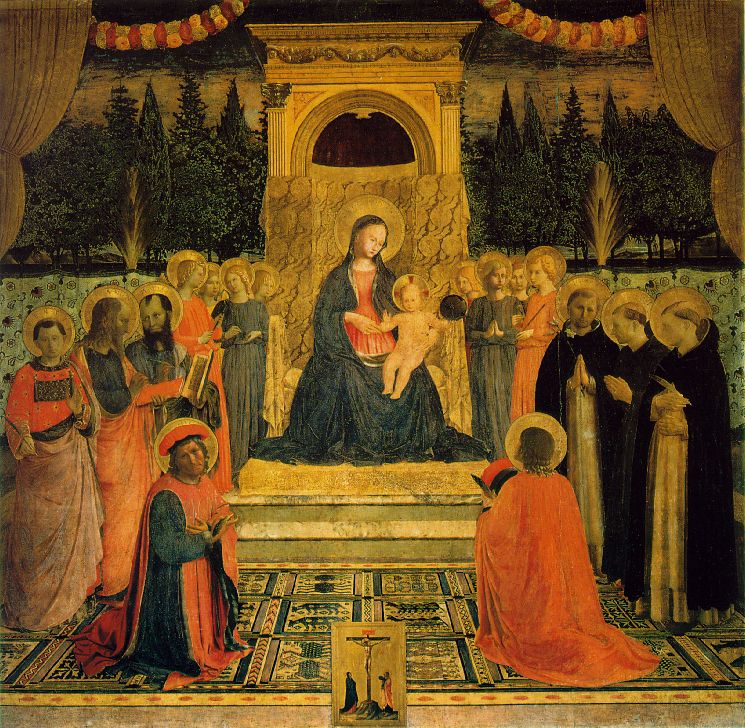
Pope Benedict believes that art can be used to overcome the complacent secularity of today’s western culture. To understand this view, think of Fra Angelico’s 15th century Madonnas. Then think about our 20th century Madonna.


Last Saturday, the Pope spoke to more than 250 of today’s leading painters, sculptors, architects, poets and directors, gathered in the Sistine Chapel. According to artdaily.org, he told the artists that he wanted to "renew the Church's friendship with the world of art."


He told them that, in a world lacking in hope, with increasing signs of aggression and despair, there was an ever greater need for a return to spirituality in art. "Too often”, he said... “the beauty thrust upon us is illusory and deceitful ... it imprisons man within himself and further enslaves him, depriving him of hope and joy."


Enjoined by the Pope, seated beneath Michelangelo’s profound 15th century Genesis ceiling, facing his Last Judgment, I have to imagine that at least some of those present were stirred by spiritual inspiration!

Sunday, November 15, 2009

Architectural clues tell the story


Just back from Rome. Glad to be home, but ... ah, Rome.

I continue to be fascinated by the visual cues to its history ... if you just know what to look for.


One thing I'd never noticed before, something I think almost everyone misses, in the Piazza di Trevi:


When facing the fountain, one's back is to an enclosed medieval portico. But if you turn around and give it a careful look, the distinct lack of symmetry in the facade gives clues to its story.


The original open portico was built in the late 13th/early 14th century, functioning as a sheltered extension of the piazza. It was enclosed in the late 17th century because it was thought to constitute a public nuisance ... its shadowy recesses providing cover for unsavory types bent on committing unsavory acts.


The portico was built with materials pilfered/salvaged from ancient structures. Use of granite columns and Ionic capitals of different sizes meant that the short entablatures had to be set in at different heights. Because of the scale differences, the spacing between the columns is uneven.


As a result of a 17th C renovation, the windows of the apartments on the floors above are placed somewhat symmetrically in relation to each other -- but there was no way to line them up with the irregular colonnade below.


Nonetheless, despite this visual dissonance, flying in the face of all that is architecturally holy, the facade has a charming stability. It will be still standing long after I'm not!


Thursday, August 20, 2009

Empire and Facial Hair

Here's another digression that is being edited out of the Jane's Smart Art audio guide to the Pantheon in Rome: a little art-historical note … about Roman Emperors' facial hair.

Their sculpted portraits tell us that, up until Hadrian’s time [117 - 138], Roman Emperors were clean-shaven. (Beards were worn until Alexander the Great made shaving fashionable, circa 300 BC.)

But Hadrian chose to wear a beard, perhaps in emulation of the Greek philosophers. His portraits evidence that he broke with clean-shaven tradition and, in so doing, he apparently established a new trend. Subsequent emperors were always portrayed sporting beards.

Thus, the presence or absence of a beard will cue you as to whether the Roman bust you are looking at is of the earlier or later Empire.
Julius Ceasar [d. 44BC]

Domitian [81 - 96 AD]

Trajan [98 - 117]

Hadrian [117 - 138]

Commodus [180 - 192]

Caracalla [211 - 217]

Wednesday, August 19, 2009

"Give us back our Apoxyomenos!"


I hate to have to edit this tidbit out of the script for my up-coming Jane's Smart Art audio guide to the Pantheon in Rome, but it's rather too much of a digression:

To celebrate their victory over Antony and Cleopatra at the Battle of Actium in 31 BC, Emperor Octavian Augustus' good friend and son-in-law, Agrippa, built the first public baths of Rome. To supply his magnificent new baths, Agrippa constructed a 14-mile long aqueduct to bring to Rome the pure water of the Aqua Virgo.

Pliny tells us that Agrippa’s baths were splendid in design and materials, and that they were decorated with fine statues, including the famous bronze Apoxyomenos by Lysippus (Ly-SIP-us) -- a beautiful figure of an Athlete in the Bath. Lysippus was Alexander the Great’s court sculptor in the 4th C BC.

Apoxyomenos means "The Scraper". It is a Classical Greek artistic convention for representing an athlete, caught in the familiar act of scraping his body with the small curved metal instrument that the Romans called a strigil. In the days before soap, perfumed oil was applied to the skin and then the strigil was used to scrape it off, drawing the dirt and sweat from the body along with the oil.

Tiberius, who followed Octavian Augustus as Emperor, moved the bronze statue to his palace for his personal enjoyment. But -- even though he replaced it with a marble copy -- the figure was so popular that the public outcry, "Give us back our Apoxyomenos", forced him to return the original to its place in front of the Baths complex.

An ancient copy in Pentelic marble — quite possibly the one Tiberius tried to substitute — is now in the Vatican. The supporting tree trunk behind the left leg seen in the Roman marble copy was not in the bronze original, which has been lost.

Wednesday, June 03, 2009

The Travels Of A Traveller's Triptych

How's this for provenance ...

A tiny 14th century enamel-on-gold traveller's devotional triptych :

  • Mary Queen of Scots had it during her imprisonment in the Tower of London; she gave it to
  • Elizabeth Vaux, wife of 4th Lord Vaux of Harrowden (gr-gr granddaugher of St Thomas More).
  • Claudio Acquaviva, General of the Jesuits 1581-1616, who gave it as a coronation gift to:
  • Pope Leo XI dei Medici (1605); it was returned upon the Pope's death to:
  • Family of Fr Aquaviva, Dukes of Atri
  • Maximilian I , Duke of Bavaria Wittelsbach (c.1616); Wittelsbach family owned it for more than three centuries, until they
  • Sold it to a Munich art dealer (1933), who sold it to
  • Fritz Mannheimer (died during WWII, wife Jane remarried Charles Wm Engelhard)
  • During war, the triptych was stored in a London bank vault; Although the bank was bombed to smitthereens, the triptych remained intact;
  • Looted from rubble by an English sailor who traded it it for drinks at an Irish pub
  • Pubkeeper gave it to a convent, whence it passed to
  • An unnamed local collector who traded it to a dealer for some chairs.
  • The dealer showed it to Fr Martin D'Arcy, (Jesuit priest, Oxford) who knew it belonged to Mannheimer (he had bid against Mannheimer for it at auction when Mannheimer acquired it.)
  • Returned to Jane Engelhard (c 1948); She gave it to D'Arcy, who was a noted collector.
  • Put on public view to celebrate the Coronation of Queen Elizabeth II (1953)
  • Evidently now on permanent loan to Victoria and Albert Museum, London

I'd love to see the tryptych, but I've been unable to find a picture of it, not even on the V&A website or the D'Arcy Museum website. Any leads?

Saturday, April 04, 2009

Baroque: The First International Style

If you’ll be in London between now and July 19th, try to get to the V&A to see their special exhibit, 1620-1800 Baroque – Style in the Age of Magnificence.

Baroque was the first artistic style to have a significant global impact. It spread from Italy and France to the rest of Europe, and then was carried to Africa, Asia, and Latin America by Portuguese, Spanish, Dutch and other European colonists, missionaries and traders. As European communities were established, craftsmen, artists and architects traveled and settled around the world. Trade in luxury goods and the distribution of art prints furthered the global dissemination of Baroque style.

Art Daily Newsletter reports today that “The magnificence and splendour of Baroque, one of the most opulent styles of the 17th and 18th centuries, is the subject of the V&A’s spring exhibition. The exhibition will reflect the complexity and grandeur of the Baroque style, from the Rome of Borromini and Bernini to the magnificence of Louis XIV's Versailles and the lavishness of Baroque theatre and performance."

Displays cover architecture, furniture, silver, ceramics, painting, sculpture, and textiles. Abnd will explore Baroque in performance and the theatre; the public city square; religious spaces including St Peter’s Basilica in Rome; and secular spaces including Louis XIV’s Palace of Versailles.

Among the roughly 200 objects on display will be religious paintings by Rubens and Tiepolo. Of particular interest to anyone who has been to Our Lady Cathedral in Antwerp is an oil sketch of the center panel of Descent from the Cross, the huge altarpiece Rubens painted for the Arquebusier Guild, which is still magnificently on view in that remarkable gothic edifice.

Mark Jones, Director of the V&A said: “Baroque is one of the most exuberant and dazzling design styles there has even been, an expression of European power and magnificence in the 17th and 18th centuries. Our exhibition will be the first to examine all the elements of Baroque including architecture, art and design and will look at how it established itself through Europe and then internationally as European power grew overseas.”

Saturday, March 28, 2009

If It Has Function, Can It Be Art?


Some art theorists insist that art is made to be seen, not used. Essayist Siri Hustvedt is one of these. In her Mysteries of the Rectangle, she says that art "has not practical function beyond visual communication between the product the artist created and the viewer.”


I don't know what Hustvedt thinks about Fountain, but even if she agrees with me that Duchamp's urinal is not art, I suspect our reasoning might not be the same ... I disagree that functional things can't qualify as art.


Take Clark Sorensen’s urinals, for example.
Titled Nature Calls, his series of one-of-a-kind, hand-made porcelain fixtures was inspired by Georgia O'Keeffe’s large-scale flower paintings.


Like Duchamp’s Dadaist Fountain, Sorensen’s Nature Calls urinals are also intended to be humorous and ironic. But unlike Duchamp, Soensen has created something original and unique, elevating the mundane into the realm of artistic expression.

Wednesday, March 25, 2009

Marcel Duchamp’s urinal ... er, "Fountain"

I don’t always succeed in appreciating a (so-called) work of art.

For example, I’ve never been able to appreciate Marcel Duchamp’s Fountain … which isn’t a fountain at all. It’s a urinal. And I’m not ashamed to say that I don’t “get” it, despite the fact that a poll of 500 art experts named it as the most influential work of modern art … ahead of works by Picasso and Matisse!

Duchamp's idea was that it’s the creative process that is the most important thing - that the work itself can be made of anything and can take any form.

Conceptually, I agree with that … but I can’t see that Duchamp actually created anything. What he did was purchase a factory-made product and hang it on a wall. And, indeed, when Duchamp shocked the art establishment in 1917, offering it for the first exhibition of the Society of Independent Artists in New York, Fountain was rejected for being neither original nor art.

Duchamp’s urinal is an example of Dadaism. According to its proponents, Dada was not art, it was "anti art", bent on rejecting traditional culture, and embracing chaos and irrationality. For everything that art stood for, Dada was to represent the opposite. Where art was concerned with long-established aesthetics, Dada ignored aesthetics. If art was to appeal to sensibilities, Dada was intended to offend. If art is a gift of the Universe, then Dada rejected the spirit of reciprocal generosity.

To my mind, even if American Dadism was driven by a sense of irony and humor, its negative purpose moves it out of the realm of art. Dadists themselves called it “anti-art”. How can something anti-art be art?

Tuesday, March 24, 2009

700 Year-Old Gift Still Elicits Gratitude


Following yesterday's posting, I remembered feeling that sense of gratitude to the Universe while looking at this sculpture in Our Lady Cathedral, in Antwerp, Belgium.

This sweet Madonna and Child was carved sometime before 1350, a gift from a long-dead, nameless artist – known to us today only as the Master of the Mosan Marble Madonnas. It's a gift that has kept on giving for almost 700 years!

The first time I saw it I knew very little about late medieval sculpture. But I was drawn instinctively to the expression of tenderness between this universal rendering of Mother and Child.

I was amazed that such grace and suppleness could be evoked in stone. The surface of the marble is so smooth and soft-looking, I wanted to reach out and stroke it.

It was only later that I learned that this sort of fluidity of pose and drapery, and the expressiveness in the baby’s playful gesture and the young Madonna’s affectionate gaze -- were extraordinary in a 14th century sculpture.

As a footnote: One might well wonder how this sculpture has remained almost completely undamaged for so long -- given that the cathedral stood central to Antwerp's tumultuous history (ie: religious iconoclasm, French revolution, world war). In fact, the statue is hollow, making it light-weight enough to be easily moved out of harm's way ... as oftern as might have been necessary!

Monday, March 23, 2009

Art as a Gift of the Universe

I haven’t posted for a rather long time because I’ve been busy pondering the meaning of life.

Actually, among the things I’ve been juggling is a treatise on the Art of Looking. As I’ve considered the subject, I’ve realized something quite fundamental about my approach to art:

I believe that a work of art is a gift of the Universe.

Here’s the spiritual logic: anything created by someone is an offering of a part of that person’s Being … an expression of the uniqueness of who that person is. We talk about a person as “gifted”. We refer to a person’s particular talent as “a gift from God”. We talk about gifts “coming from the heart”.

When a child gives us an off-kilter clay something-or-other, we are delighted … we recognize the care and concentration and the effort that went into it, and we receive it as a gift of that child’s Being … even while wondering what it is!

The extent to which you at least try to appreciate the work is an expression of your gratitude for the gift. It’s a reciprocal relationship. Taht may sound a little flaky … but so often when looking at an amazing work I feel a profound gratitude to the Universe that human beings are able to create such things.