Saturday, December 16, 2006

St. Paul's New Morality

I've long been uncomfortable with the saying, "That's not very Christian ... ." It strikes me as insulting to all the good people who hold other theological beliefs. But when I overheard it said again recently, I began to wonder what it really means.

I'm currently reading Bruce Shelley's Church History in Plain Language, and I've just come across the answer to the question. Shelley attributes the following words to the apostle Paul:
"The fruit of the Spirit is love, joy, peace, patience, kindness, goodness, faithfulness, gentleness, and self-control." (Galatians. 5:22-23)

According to Shelley, "Spiritual regeneration and the moral life were not merely one side of Christianity to Paul but its very fruit and goal on earth."

Little wonder, then, that the new Christian message was so appealing to so many in the Roman world -- where slavery, cruel punishments like crucifixion, and beastly entertainments like gladiatorial combat were accepted. Paul himself, initially a persecutor of those Jews who believed in Christ as the Messiah, "saw the light" and became an apostolic messenger. Caravaggio represented Paul's conversion in this image in the Cerasi Chapel in Sta. Maria del Popolo in Rome.

So, "That's not very Christian ... " refers to the moral origins of Christian belief. Others can of course be good, moral people. But to be a true Christian requires living to a high standard of "love, joy, peace, patience, kindness, goodness, faithfulness, gentleness, and self-control."

Does the most moving Christian art reflect this spirit?

Wednesday, November 29, 2006

Alinari National Museum of Photography Now Open

A month ago, in Florence, the new Alinari National Museum of Photography opened in a renovated historic structure in Piazza Santa Maria Novella.

Now the collection from the fabulous Alinari Archives will be displayed to the public, representing an astonishing patrimony of documentary material pertaining to art, history, folklore, landscape, industry and society. The particularly exciting thing to me is that Alinari has, from the beginning, specialized (among other things) in the documentation of works of art and historic monuments.

Founded in Florence in 1852, Fratelli Alinari is the oldest photography firm in the world. Through Alinari photographs – dating from the second half of the 19thC to the present – the history, society, art and culture of Italy and Europe and the rest of the world, have been preserved and catalogued.

Alinari owns more than 3.5 million images, plus the firm manages or represents more than 21 million photos owned by other organizations, including 400,000 images from the archive of the Touring Club Italiano.

Not going to be in Florence any time soon? You can gain on-line access to the Alinari Archive at http://www.alinariarchives.it/login/index.asp?languageID= The website also has a bookstore with interesting books of photography, and also selections of cards.

According to the official press release announcing the opening, “The itinerary begins with the year 1839, with the first daguerreotypes, and goes as far as the digital images and photocellular phones of today. It is a fascinating itinerary that journeys through the era of the pioneers; the new world of a picture that can be technically reproduced, thus revolutionizing possibilities for knowing and seeing; … the relentless technological advances which created a market for everyone; photography which refines its language to become an art; and an infinite number of promotional objects. Hundreds of rare photographs, vintage objects, cameras of the past and the most up to date … in a presentation designed by the Oscar winning film director Giuseppe Tornatore."

There is also a space for temporary exhibits. The first themed display is called View of Italy, 1841-1941: The Great Masters of Italian Photography in the Alinari Collections.

Finally, one very interesting first-of-its-kind experiment that the Museum developed in collaboration with the Stamperia Braille of the Region of Tuscany is the “touch tour for the blind.” It’s a unique collection of 20 pictures re-created in relief to be seen by the blind through touch. Even as a sighted person, I look forward to experiencing the touch tour. I wonder if feeling the dimensionality of an image will enhance my seeing in any way.

In the words of Florence’s mayor Leonardo Domenici “The MNAF ( Museo Nazionale Alinari della Fotografia) is a new treasure for Florence, a museum of modernity of exceptional cultural value. It also has allowed the city to reclaim in the best of ways the historical Leopoldine complex threatened with deterioration. Once restoration is completed the complex will also house the Museo del Novecento (20th C) dedicated to contemporary Italian art.”

I won’t be in Florence again until next Fall, so I’ll have to make do ‘til then with on-line access to the archive. But the MNAF will definitley be on my itinerary when I do get there!

Tuesday, November 14, 2006

Fra Angelico Hiding in the Bedroom!


If you have a love for early Renaissance art -- perhaps Fra Angelico in particular -- (or if you're a fan of The Antiques Roadshow) the recent discovery of two Fra Angelico panels in a modest home in Oxford, England, should give you a little shiver of excitement!

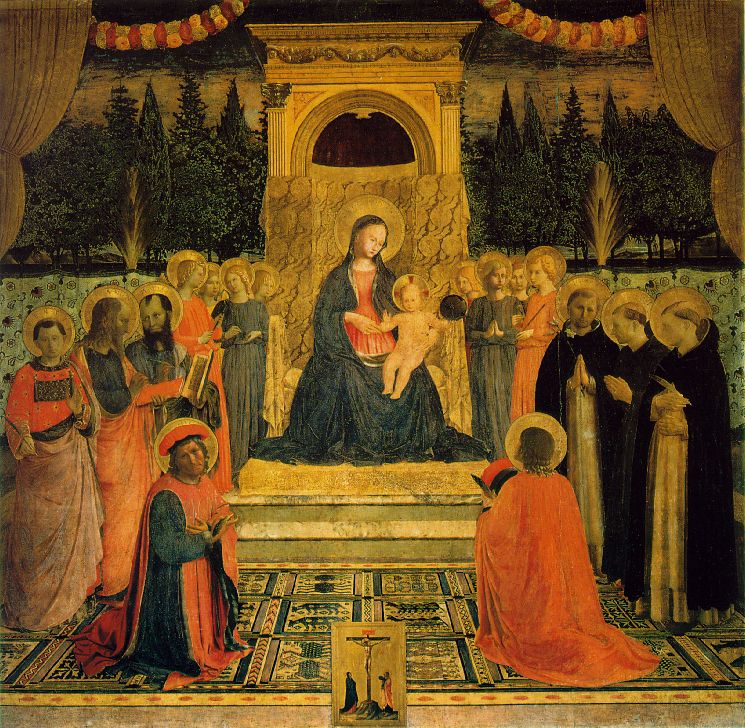
The panels are recognized by art experts as being from the San Marco Altarpiece, painted by Fra Angelico, c. 1439, commissioned by Cosimo dei Medici. The central panel of the altarpiece is still at San Marco, but the smaller panels surrounding it were dismantled 200 years ago during Napoleon's occupation of Italy. Today most of these secondary panels can be seen in Museums scattered around the world. Some, however, remained unaccounted for, including these two. I wonder how many of these little treaures remain lost.

According to a Reuters report from London, two panels painted in tempera on a gold background, each showing a standing figure of a Dominican saint, were found tucked away behind a bedroom door by an art auctioneer who had been asked to carry out a valuation after the owner of the house died in July. The homeowner, a librarian, had retrieved the paintings from a box of odds and ends while working as a manuscript curator at a museum in Huntington, California, in the 1960s. Unaware that they were by Fra Angelico, she thought they were "quite nice" and persuaded her father to buy them for a few hundred pounds. Today, they are expected to bring more than a million pounds at auction.

"We are dealing with two works of art painted by one of the 'greats', intended for his own church and commissioned by one of the greatest art patrons in history," the auctioneer, Guy Schwinge, said in a statement. "It simply does not get much better than that."

Wednesday, November 01, 2006

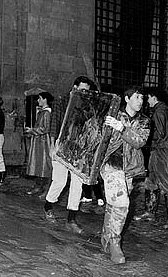
Angels Of The Mud


On November 4th, 1966 -- after days of rain -- the Arno flooded its banks to a depth of roughly 12 feet, destroying everything in its path. As an impassioned 16-year-old, I had fallen in love with Florence in April of that year, and I remember that hearing the news of the flood affected me as nothing had ever done before in my short life. When I heard that people from all over the world were converging to help with the clean-up, I begged my parents to let me take a semester off from high school ... to no avail.

If I were forced to produce a list of my regrets in life, that would be one of them. Had I been a couple of years older I would have gone to Florence to be one of what were soon dubbed as "gli angeli del fango" -- the angels of the mud.

The official Angeli del Fango website is definitely worth looking at, with photos and videos and eye-witness accounts of the event and its aftermath. To see images of the water rushing through streets and past the Duomo, and to see priceless frescoes and sculpture blackened with filth is really sobering. It's hard to imagine today what an undertaking it was, how extensive was the damage to a vast amount of irreplacible art.

This Saturday will be the 40th anniversary of that heart-wrenching event, and a reunion of "gli angeli" will take place in Florence.

Hats off to the volunteer angels and the professional restorers who slogged through muck for months,living in seriously uncomfortable conditions, to reclaim the city's artistic and architectural heritage from the mud.

Friday, October 27, 2006

Pope Descends into Chasm in the Earth


I've just come across something that I would definitely have included in the Jane's Smart Art Audio Guide to St. Peter's Basilica had I known it.

According to R.A. Scotti, in her recent book about the building of St. Peter's, Basilica, the trench excavated for the foundation of Bramante's enormous piers was 25 feet deep. Think about it ... dug by hand, the mucky soil drawn up from the depths, bucket load by bucket load ... a 25 foot deep trench running the circumference of each massive pier is a huge amount of earth-moving!

Scotti's description of the ceremony which was held at first light on April 18th, 1506, is delightful. She tells of a fierce wind whipping at the cardinals' crimson cassocks, and the bull-like figure of Pope Juilius II visible above the sea of humanity, tossing commemorative coins into the crowd as he was borne to the site, seated in a sedia gestatoria.

"Two masons descended first, followed by two cardinals, and then the pope, grim-faced. He climbed down the ladder carefully, his ringed fingers grasping the rungs, encumbered by the heavy clothing, the weighty tiara, descending lower, lower yet. The Ager Vaticanus was marshy, the earth in the pit damp, the air close."

"As Julius disappeared into the trough, the crowd pressed forward for a better view. Dirt flew, striking his tiara. For a terrifying moment he thought the sides would cave in and bury him. ... The trench was 'like a chasm in the earth,' the papal master of ceremonies, Paris de Grassis, recorded in his journal, 'and as there was much anxiety felt lest the ground should give way, Pope Julius thundered out to those above not to come to nearer the edge.'"

I love the visual image of this burly white-haired pontiff, larger-than-life and glorious in voluminous brocade, jewels a-glitter, descending gingerly into the muddy pit to lay the first stone in the foundation of what was to become, over the course of two centuries, one of the most remarkable achievements of the Renaissance.

Sunday, October 15, 2006

One ought to be required to pass a test before being permitted to enter St. Mark's

Miss Julia Garnet's severe schoolmarmishness was overwhelmed by the mysteries and aesthetics of Venice. Nonetheless, stern criticism did still invade her new-found generosity of spirit from time to time:

"The Japanese were out in force again. A party stopped and aimed a bank of phallic cameras at Adam and Eve. No wonder they felt embarrassed in their nakedness. Julia turned aside in disgust. Really, she thought, it should be made difficult not more easy to get to places of beauty. One ought to be required to pass a test before being permitted to enter St. Mark's."

This passage evoked my own recollections of techno-buff tourists with their large-lensed digitals or purring video cameras. Yes, they are often Japanese - who do seem to travel in little swarms --but most any nationality can be substituted in this picture.

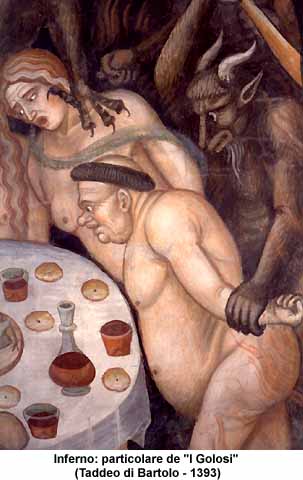
Julia's uncharitable thoughts about the Japanese in St. Mark's Basilica reminded me of an incident in the Duomo, called La Collegiata, in San Gimigniano. I had been standing for a long time, awe-struck, below Taddeo di Bartolo's Last Judgement, taking in the gruesomely graphic -- even pornographic, some might say -- portrayal of what the Damned have to look forward to on the day of judgment. Out of respect for some readers' sensibilities, by way of illustration I have chosen to show Gluttony, one of the tamer details of the fresco.

Despite knowing that the intent of the horrific scenes was to strike fear in the hearts of mortal Christians, I was startled to find such images in a church, and I stood crunching my neck in the dim light, trying to take it all in. Suddenly, a tall, lanky middle-aged American man was at my elbow. His video camera whirred softly as he panned down the length of the fresco, his voice reverently low as he recorded his caption, "This is another painting in another church in Italy."

Guessing that he had no idea what he'd just filmed, I resented the intrusion --- until I imagined him getting home and sitting Granny and the kids down to show them the video of his trip to Italy. SURPRISE! That brought tears of malicious mirth to my eyes! Just that morning I had been lamenting how crowded Europe has become, as great numbers of people from all over the world have gained the economic means to travel. If they travel because they are really interested, I thought, that's a good thing. But if they are simply accumulating bragging rights, adding one more place to the list of where they've been, then that's something else entirely! In retrospect, it was very Miss Garnet -- strict and uncharitable -- of me!

Miss Garnet's Angel by Salley Vickers would be a delightful book to read before your next trip to Venice. I suppose some might read it as a simple story of a spinster tuning in to Venice. But, as the layers are peeled back, there's a thought-provoking ethereal depth to it that I found intellectually gratifying.

Friday, October 06, 2006

Living in the moment with limoncello

We've just spent a couple of days mellowing out at a yoga retreat. On the drive home, I was thinking about the rather spartan, almost-vegetarian meals we'd been eating, and ... maybe I dozed off or something ... suddenly I found myself dreamily reliving meals I've had in Italy. Anything but spartan... and I've certainly never gone three days in Europe without a glass of wine!

Perhaps it was the retreat's ubiquitous jugs of water packed with lemon slices that made me think of limoncello. In Rome, we often stay in an apartment around the corner from Sta. Maria della Pace, and when we do, we frequent the little neighborhood osteria that's tucked in just steps from our 15thC doorway. (Osteria del Pegno, Vicollo Montevecchio,#8) The last time we stayed there we supped at del Pegno the night before our early morning departure for home. We had planned to eat and run, get packed and go to bed.

But that plan changed when we asked for the check. Instead of il conto, two frosty little glasses of limoncello were delivered to our table, compliments of the house. I suspect the waiter picked up on -- and disapproved of -- our haste, and this was his subtle way of making us slow down and live in the moment! And it did do just that ... we lingered over the tangy liqueur, then decided to take a leisurely dawdle around the neighborhood before going up to pack. We strolled over to the local alimentari and bought a bottle of limoncello to bring home with us, even though we seldom carry anything back that we know we can get here.

Anyway, having thought about this sweet experience yesterday, today quite coincidentally I came across an article about limoncello at the Dream of Italy website which, after providing some fascinating historical and cultural background, provides a recipe for concocting limoncello at home.

Well, I seem to have produced another food-related posting, with no mention of art and history ... I don't think referencing the history of limoncello really counts. I'll get back on track next time, I promise!

Tuesday, September 19, 2006

Mangia Bene - Gelato's a Good Thing !

This post has nothing to do with art or history, but everything to do with Roma! If you happened to read my interview featured on TangoDiva.com, you'll know that when I'm in Rome I can often be seen prowling the streets in the deep of night, in search of il gelato perfetto. Giolitti, near the Pantheon, has long been my favorite gelateria, as it is for so many gelatophiles.

I've just come across a July 21st dispatch on WorldHum by Valerie Ng -- a fellow Giolitti fan -- on How to Find Good Gelato in Italy. I was delighted to learn from her article that, while ice cream as we know it has a butterfat content of as high as 30%, "gelato is typically made with milk, water or soy as a base, and it has a fat content of between 1% and 10%." Ng points out that besides being healthier than ice cream, gelato's lower fat content allows one to experience the flavor more clearly, without a blanket of saturated fat dulling the tastebuds.

It seems somehow counter-intuitive that a sweet treat that's lower in fat would actually be yummier! Ahh, but what good news for those of us who have always felt we should confine ourselves to a single scoop!

Monday, September 18, 2006

Michelangelo's Late-Life Accomplishments

I've heard people as young as 50 lament that their productive years are behind them. Perhaps it's the times, our society's idolatry of youth. Surely, the speed of technological change contributes. Perhaps in Michelangelo's day, the wisdom and experience gained over years was valued more than it is today. But to anyone who thinks (s)he's all washed up at 50, I say, "Consider Michelangelo's productivity after age 50 ..."

After 50, he sculpted 15 statues, including the masterful Dawn, Dusk, Night and Day in the Medici Chapel in Florence.

From age 62 to 67 he painted the Last Judgement in the Sistine Chapel, and then frescoed The Conversion of St. Paul and the Crucifixion of St. Peter in the Pauline Chapel. He was 76 when he finished them.

He became an architect! He designed and supervised the building of The Laurentian Library in Florence, and in Rome, the 3rd story cornice and courtyard of the Farnese Palace, the Piazza del Campidoglio on the Capitoline Hill, the Porta Pia, St. Peter's Basilica and its amazing dome, and ... at age 88 ... he designed the conversion of a portion of the Baths of Diocletian into the church of Santa Maria degli Angeli!

Wednesday, September 13, 2006

How a Centuries-Old Fresco Is Removed From The Wall

A couple of months ago I visited the The Cloisters in Fort Tryon Park in upper Manhattan. The Cloisters is a branch of New York's Metropolitan Museum of Art, devoted to the art and architecture of mediaeval Europe. The construction of the neo-mediaeval building and its cloisters incorporated Romanesque and Gothic architectural fragments, dating from the eleventh through the fifteenth centuries, originating primarily in Spain and France. They were brought over from Europe in the 19thC by an American sculptor, George Grey Barnard, and assembled on this site as a museum for Barnard's collection, through the generosity of John D. Rockefeller, Jr.

A stone castle with cloistered gardens, set high on a bluff overlooking the Hudson River, the setting itself was worth the trip, and the mediaeval atmosphere added to my enjoyment of the art treasures on display: sculpture, tapestries, illuminated manuscripts, goldsmiths' and silversmiths' work, stained glass and enamels and ivories, and ... .

I joined a docent-led tour, which I found disappointing. It added little to what I already knew. I guess I was hoping for something along the lines of a Jane's Smart Art Guide -- that is, more substance -- for the highly-motivated person who already has some background in the subject.

Our guide wasn't able to answer the one question I posed -- "How is a fresco removed from the wall it was originally painted on?" Not only did I think he should have known, I realized that I shouldn't have had to ask!

I've wondered this before, 'though never urgently enough to look into it. This time, however, the fresco in question had been painted on a curved wall, centuries ago, in Spain. It had been removed from that wall and transported across the ocean, to be integrated into the decoration of a chapel at The Cloisters -- still (or again?) curved! There was something about the fact that it had been removed from a curved support, rather than the usual flat wall, that pushed my curiosity over the brink, into research mode!

First, it helps to understand the fresco painting technique:

Unlike a mural, which is painted onto a dry wall surface, a fresco becomes part of the wall it's painted on -- literally part of the architecture. The fresco painter would begin by preparing the wall with a coat of coarse plaster, called “arriccio”. The Italian word “fresco” -- meaning wet or "cool” -- refers not to the paint but to the surface to which the paint is applied. The surface would be coated with a finely ground plaster, which was often mixed with marble dust to increase its smoothness. This plaster -- called “intonaco”-- would be applied in very thin layers over the arriccio, whose rough surface provided the necessary adhesion.

The paint used in these mural paintings, like all paint, is made of a colored powder or pigment suspended in a medium that makes it into a liquid, which becomes a paint film when it dries. In fresco painting, the binding medium is glue and limewater. When applied to wet plaster, the limewater causes the paint to bind with the wall itself. When dry, this sort of traditionally-applied fresco painting -- known as “buon fresco” -- becomes an actual part of the wall.

Because both the paint and plaster were quick to dry, this meant that painters had to plan to work in single sessions, on patches of fresh plaster: called “giornate,” after the Italian word meaning “day’s length.”

Art conservators have learned how to separate the intonaco layer of a fresco from the underlying arriccio. The technique had to be used, for example, to save a number of frescoes in Florence after the Arno flooded its banks in 1966 and damaged numerous important Renaissance works.

A fresco is removed from the wall by being transferred onto canvas, using what's known as the "Calicot method": invented by someone named Calicot, I presume. There are two processes used, depending on the condition of the underlying plaster:
"strappo da muro" = "pulling [of the fresco] from the wall" (strappare = to pull away) and "stacco" (staccare: to detach).

The stacco process detaches the fresco painting from the wall by removing the entire intonaco layer. A special water-soluble glue is applied to the painted surface and then two layers of cloth (calico and canvas) are applied. When the glue is dry, the cloth is peeled from the wall -- very carefully, I imagine! --pulling the painted intonaco with it. Once the fresco is off the wall, stuck to the cloth, it's taken to a laboratory where the excess plaster is scraped away and a fresh canvas is attached to the back with a permanent glue. This done, the water-soluble glue is dissolved and the cloths on the face of the fresco are removed. At this point, the fresco is ready to be mounted on a new support: the canvas stretched on a frame, like a regular painting, or glued to a solid base.

The strappo process is used when the plaster on which a fresco is painted has deteriorated badly. Strappo takes off only the color layer with very small amounts of plaster. The glue that's used in strappo is considerably stronger than that used in the stacco technique, but the procedure that follows is same. Sometimes when a fresco is removed by means of strappo, a colored imprint may still be seen on the plaster remaining on the wall, evidencing the depth to which the pigment originally penetrated the wet intonaco.

And that's how they managed to get The Cloisters' fresco off a curved wall, and back onto a curved wall!